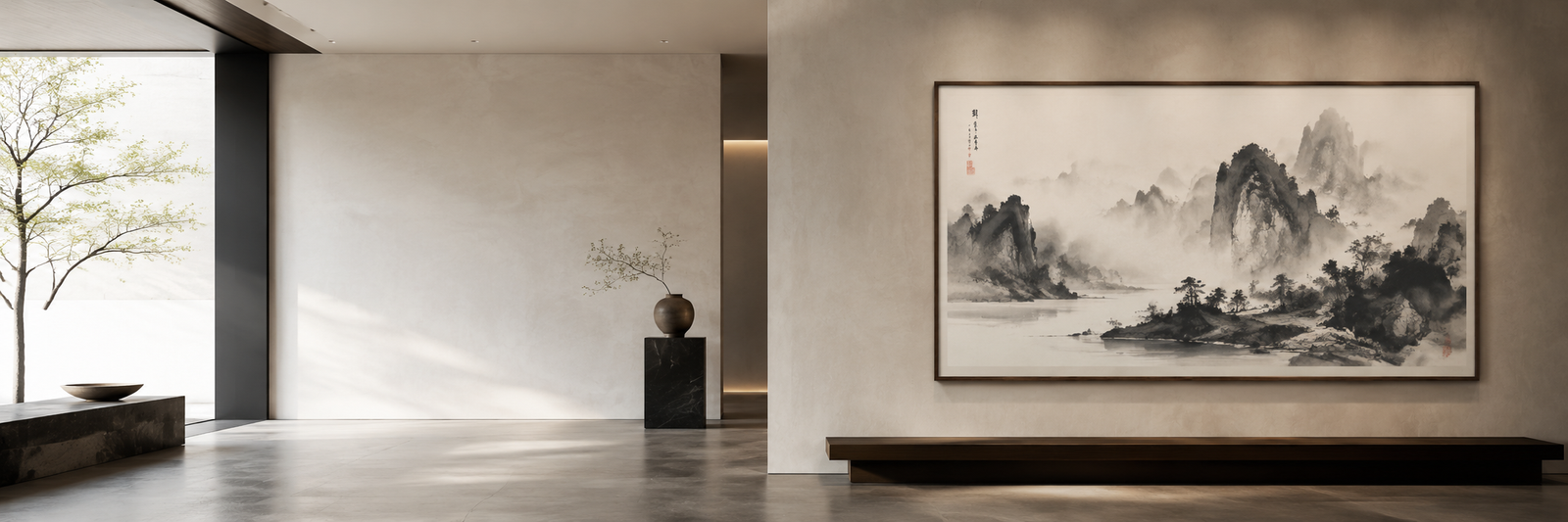
Chinese landscape painting has never been simply about recording a place. Mountains, rivers, mist and empty space have long offered artists a way to think about distance, memory, movement and the position of the individual within a larger world.
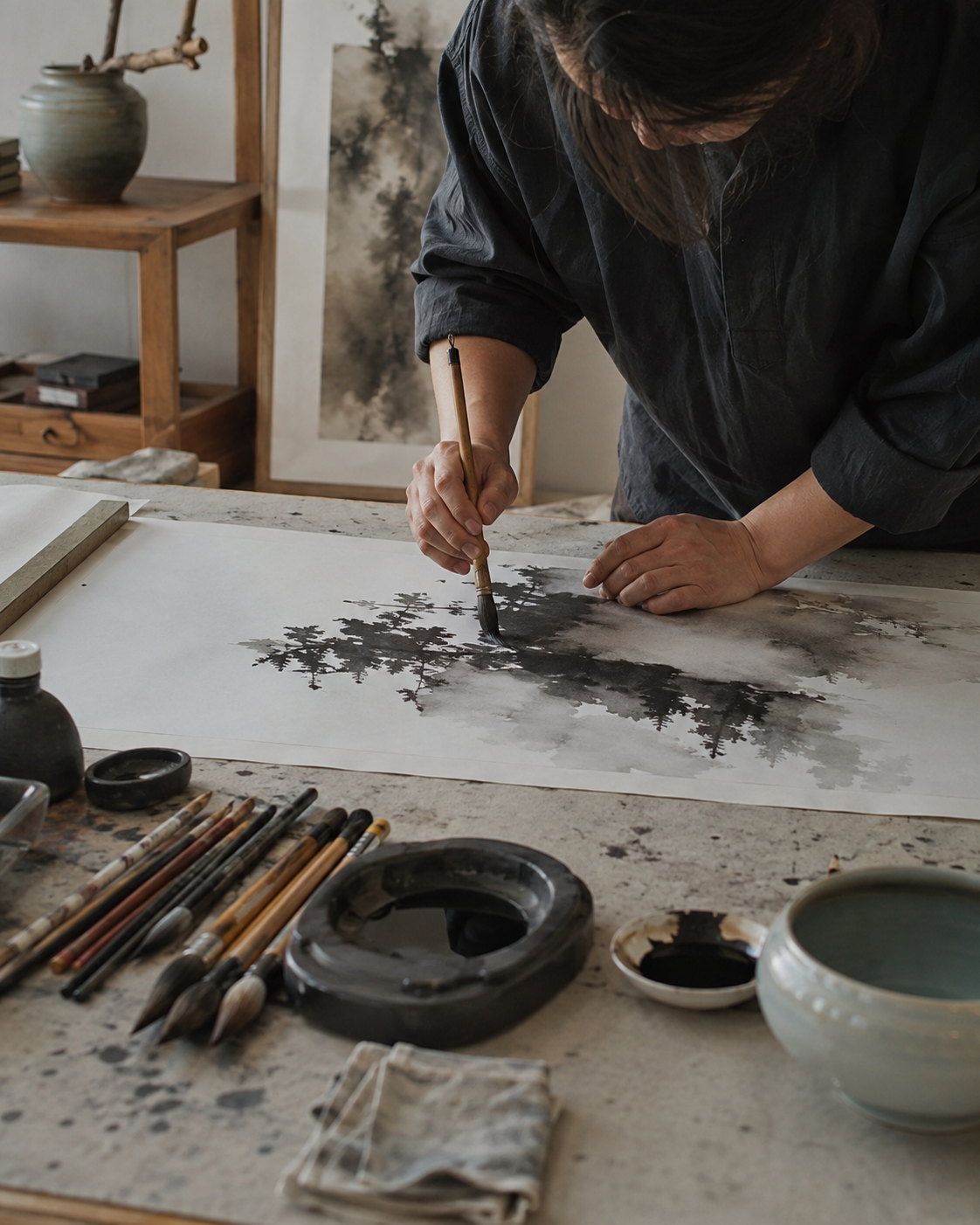
In contemporary practice, this visual language continues to evolve. Traditional materials such as ink and Xuan paper remain present, but they are no longer bound to a single historical vocabulary. Artists work between inherited techniques and present-day experience, allowing familiar forms to become quieter, more fragmented or more personal.
The Weight of Silence brings together works that explore this space between tradition and contemporary life.
A mountain in a painting does not need to describe a real mountain. It may instead hold the memory of a journey, an imagined place, or the emotional distance between the artist and a landscape once encountered.
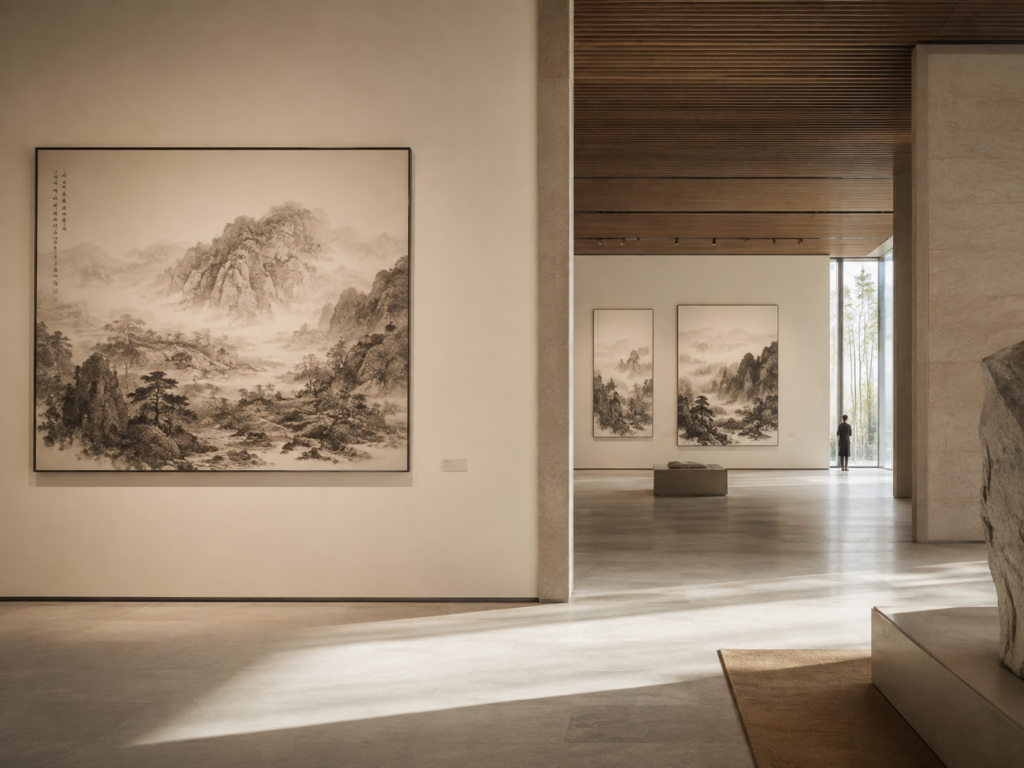
In many contemporary ink works, recognizable scenery appears only partially. Mountains emerge from washes of pale ink, architecture is reduced to a few lines, and empty paper becomes as important as the painted forms themselves.
This restraint creates space for the viewer. Rather than being told exactly where to look, we are invited to move slowly through the work and complete part of the landscape ourselves.
One of the most distinctive qualities of Chinese painting is the active use of emptiness.
Unpainted areas are not simply unfinished parts of the composition. They may suggest mist, water, light, distance or a place beyond what can be seen. In a contemporary interior, this visual openness can have an equally powerful effect.
A work does not need to dominate a room in order to change it. Sometimes its presence comes from what it leaves unsaid.
The quieter the composition, the more attention we begin to give to material, texture and subtle changes of tone.
Contemporary Chinese artists often work with deep awareness of historical painting traditions while also responding to the world around them.
Some retain classical brush techniques but alter scale and composition. Others combine ink with mineral pigments, contemporary imagery or more abstract forms. The result is not a rejection of tradition, but an ongoing conversation with it.
What remains consistent is an attention to rhythm, balance and the relationship between mark and space.
The experience of an artwork changes when it leaves a studio or gallery and enters a home.
Natural light shifts across the surface throughout the day. The distance from which the work is viewed changes. A painting becomes part of everyday routines rather than something encountered only briefly.
Quiet works often reward this kind of long-term viewing. Details that seem almost invisible at first begin to emerge over time: the edge of a brushstroke, variations in ink density, or the texture of paper beneath a pale wash.
To live with such a work is not necessarily to understand it immediately. It is to allow a relationship with it to develop slowly.
Explore the collection to discover contemporary Chinese works shaped by landscape, material and memory.